Is a 240W Power Bank Necessary? Who Should Buy One?
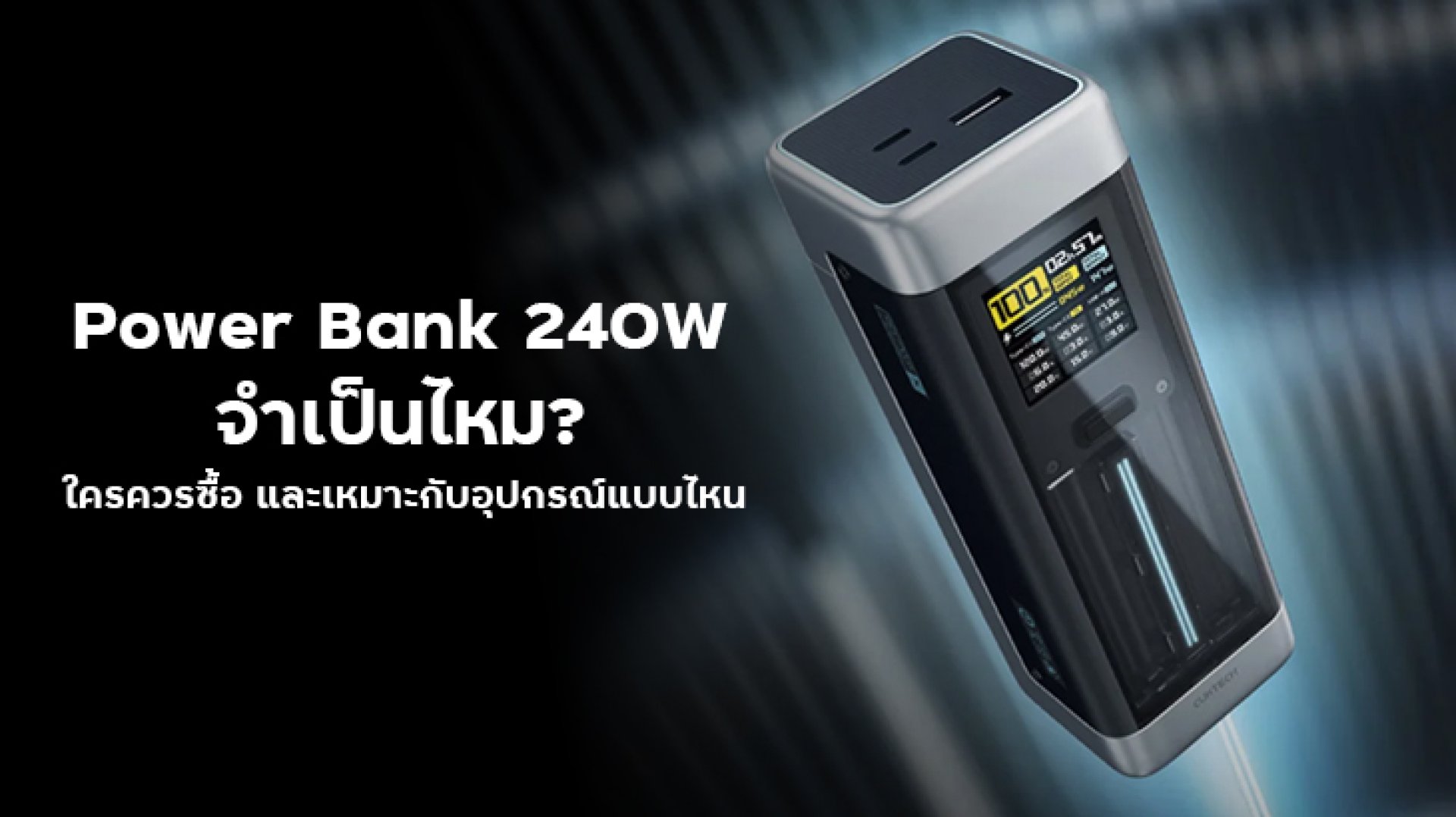
Have you seen the latest Power Banks offering up to 240W and wondered, "Do I really need that much power?"
Power Banks are now available in many different power levels, including 20W, 30W, 65W, 100W, 140W, and 240W. A higher number may sound like faster charging, but in reality, a 240W Power Bank does not automatically charge every device faster.
240W is the maximum power level supported by USB Power Delivery through USB PD 3.1 Extended Power Range (EPR). The standard introduces 28V, 36V, and 48V voltage levels, corresponding to maximum power levels of 140W, 180W, and 240W respectively, when the complete system supports them.
What Is a 240W Power Bank?
A 240W Power Bank is a portable battery designed to provide up to 240W of power through USB-C Power Delivery under supported conditions.
This capability is associated with USB PD 3.1 EPR, which extends USB Power Delivery beyond the previous 100W power range.
| USB PD Level | Voltage | Maximum Power |
|---|---|---|
| Previous USB PD | Up to 20V / 5A | 100W |
| PD 3.1 EPR | 28V / 5A | 140W |
| PD 3.1 EPR | 36V / 5A | 180W |
| PD 3.1 EPR | 48V / 5A | 240W |
Therefore, 240W is not simply a marketing number. It represents a defined high-power capability within USB Power Delivery EPR.
Does a 240W Power Bank Always Deliver 240W?
No.
240W is the maximum supported power level, not the amount of power the Power Bank continuously delivers.
USB Power Delivery allows connected devices to communicate and negotiate their power requirements. If a smartphone supports only 45W, it will not suddenly receive 240W just because it is connected to a 240W Power Bank.
For example:
| Device | Supported Power | Using a 240W Power Bank |
|---|---|---|
| Smartphone | 45W | Draws power according to its capability |
| Tablet | 65W | Draws power according to its capability |
| Laptop | 100W | Can receive up to its supported level |
| High-Power Laptop | 140W | Can use higher power if the system supports it |
| 240W-compatible device | Up to 240W | Can potentially use up to 240W when the complete system supports it |
USB-IF explains that USB Power Delivery allows devices to negotiate the amount of power they require.
Is a 240W Power Bank Necessary?
The answer depends more on what you want to charge than on the maximum output of the Power Bank.
If you mainly use a smartphone, tablet, or laptop that requires no more than 65W100W, choosing a 240W Power Bank does not automatically make charging faster.
However, if you use a USB-C device that requires more than 100W, a Power Bank supporting USB PD 3.1 EPR can provide a higher power ceiling.
Who Should Buy a 240W Power Bank?
1. Users With High-Power USB-C Laptops
The first group that can benefit from a high-output Power Bank is users with laptops capable of accepting more than 100W through USB-C.
If your laptop supports 140W or higher, a 100W Power Bank can become the limiting factor. A Power Bank supporting USB PD 3.1 EPR can provide access to higher power levels when the laptop supports them.
2. Users Who Need One Power Bank for a Laptop and Other Devices
If you travel frequently and want one Power Bank for your laptop, tablet, and smartphone, a higher-output model can provide greater flexibility.
However, check the output specification of each port. A Power Bank rated at 240W does not necessarily mean that every USB-C port can individually deliver 240W.
3. Users Who Want More Power Headroom
If you frequently upgrade your devices, a high-output Power Bank can provide additional power headroom for newer USB-C devices.
However, buying more power than your devices can use does not automatically improve charging speed. A 45W smartphone will still charge according to its own capabilities.
Who Does Not Need a 240W Power Bank?
For many everyday users, a 240W Power Bank can be more than necessary if their main devices are smartphones and tablets.
For example, if your smartphone supports 45W and your tablet supports 65W, a suitable 100W or 140W Power Bank may already provide sufficient output.
Therefore, do not assume that 240W automatically means better.
The more important question is:
How much power can your devices actually accept?
240W Power Bank vs 140W vs 100W
| Power Bank Output | Suitable For | Typical Use |
|---|---|---|
| 100W | Smartphones, tablets, and many laptops | General USB-C and laptop charging |
| 140W | Laptops requiring more than 100W | USB PD 3.1 EPR-compatible laptops |
| 240W | High-power USB-C devices | USB PD 3.1 EPR applications requiring very high power |
This does not mean that every device in each category requires that exact Power Bank output. Actual charging power depends on the device's specifications and the negotiated USB Power Delivery profile.
Does a 240W Power Bank Require a 240W USB-C Cable?
If you want to operate a USB-C system at up to 240W, the complete charging system must support the required power level, including the cable.
USB-IF provides power-rating markings for USB-C cables through its compliance programs, including 60W and 240W cable ratings.
USB-IF USB Type-C Cables and Connectors
For a 240W USB-C cable, USB-IF requirements cover testing related to USB Power Delivery 3.1 EPR and USB Type-C specifications before the cable can use the applicable USB-IF 240W power-rating mark.
USB-IF USB Type-C Cable Power Rating Logo Usage Guidelines
Does a 240W Power Bank Need an E-Marker Cable?
E-Marker technology is relevant to certain USB-C cables used for higher-power applications. The electronically marked cable can communicate information about its capabilities to the connected system.
For high-power charging, choose a cable with a clearly stated power rating and specifications that match the intended charging system.
USB-IF USB Type-C Cable and Connector Specifications
Can a 240W Power Bank Charge a 45W Smartphone?
Yes. As long as the Power Bank and smartphone support compatible charging standards and power profiles.
The smartphone will draw power according to its own capabilities. It will not be forced to accept 240W simply because the Power Bank can provide up to 240W.
This is similar to using a 100W charger with a smartphone that supports 45W. The 100W rating describes the maximum capability of the power source, while the smartphone draws power according to its own requirements.
Does a 240W Power Bank Charge a Laptop Faster Than a 140W Model?
Not necessarily.
If a laptop supports a maximum of 140W, switching from a 140W Power Bank to a 240W Power Bank will not make the laptop accept 240W.
A 240W Power Bank becomes more useful when the connected device supports power levels above 140W or when the user wants additional power headroom for high-power USB-C devices.
Always check the laptop's official charging specifications before choosing a Power Bank.
What to Check Before Buying a 240W Power Bank
- Maximum Output: Check which USB-C port actually supports 240W.
- USB PD Version: Check whether USB PD 3.1 is supported.
- EPR Support: Confirm EPR support for power above 100W.
- Power Profiles: Check the supported voltage and power levels.
- Laptop Input: Check how much power your laptop can actually accept through USB-C.
- Cable Rating: Use a USB-C cable with the appropriate power rating.
- Multi-Port Output: Check whether power is reduced when multiple devices are connected.
- Battery Capacity: Check Wh or mAh in addition to output power.
Do not focus only on the 240W number. The actual charging experience depends on how all of these components work together.
240W Output and Battery Capacity Are Different
One common misunderstanding is confusing W with mAh.
W (Watt) describes power output, while mAh is commonly used to describe battery capacity.
Therefore, a 240W Power Bank does not automatically have a larger battery capacity than a 100W Power Bank.
When comparing Power Banks, consider Output Power + Battery Capacity + Port Configuration together.
What Is a 240W Power Bank Best Used For?
- Charging high-power laptops through USB-C
- Traveling with one Power Bank for a laptop and multiple devices
- Charging USB-C devices that require more than 100W
- Using USB PD 3.1 EPR-compatible devices
- Providing additional power headroom for high-power USB-C equipment
Is a 240W Power Bank Suitable for Everyone?
No.
If you mainly charge smartphones and tablets, a 240W Power Bank may not provide a meaningful advantage because those devices may support much lower charging power.
On the other hand, users with high-power USB-C laptops can benefit more from a Power Bank supporting USB PD 3.1 EPR.
The key question is not simply "Is 240W more powerful?"
The better question is:
"How much power does my device actually support?"
Conclusion: Is a 240W Power Bank Necessary?
A 240W Power Bank is not necessary for everyone.
240W represents the highest power level supported by USB Power Delivery through the relevant USB PD 3.1 EPR configuration. USB-IF defines 48V as the voltage level associated with up to 240W when the complete system supports it.
For everyday smartphone and tablet users, a 100W Power Bank or another output level appropriate for their devices may be sufficient. Users with high-power USB-C laptops may benefit more from 140W or 240W Power Banks.
Before buying, check PD version, EPR support, maximum output, laptop input, cable rating, and multi-port output instead of looking at the 240W number alone.
FAQ: 240W Power Bank
Is a 240W Power Bank necessary?
Not for everyone. If your devices require less than 100W, a 100W Power Bank or another suitable output level may be enough. Users with high-power USB-C laptops can benefit more from USB PD 3.1 EPR Power Banks.
Does a 240W Power Bank charge smartphones faster than a 100W Power Bank?
Not necessarily. A smartphone charges according to its own supported charging power and compatible Power Delivery profile. It does not automatically draw 240W from a 240W Power Bank.
Can a 240W Power Bank charge a laptop?
Yes, if the laptop supports USB-C Power Delivery and the Power Bank provides a compatible Power Delivery profile. The actual charging power depends on the laptop's specifications.
What is the difference between a 140W and 240W Power Bank?
Both can use USB PD 3.1 EPR. The 140W level corresponds to 28V/5A, while the 240W level corresponds to 48V/5A within the USB PD power levels.
Does a 240W Power Bank require a 240W cable?
If you want to operate the system at up to 240W, use a USB-C cable rated for the required power level and verify that the Power Bank and connected device also support the necessary USB PD capabilities.
Related Articles
- Power Bank 100W vs 140W vs 240W: What's the Difference?
- What Is a PD 3.1 Power Bank? Why Can Some Models Charge Laptops at 140W?
- What Cable Do You Need for a 100W Power Bank?
- USB-C 100W vs 240W Cable: What's the Difference?
- What Is E-Marker? Why Do 100W / 240W USB-C Cables Need It?
- USB-C PD 3.0 vs PD 3.1: What's the Difference?