What Is a PD 3.1 Power Bank? Why Can Some Models Charge Laptops at 140W?
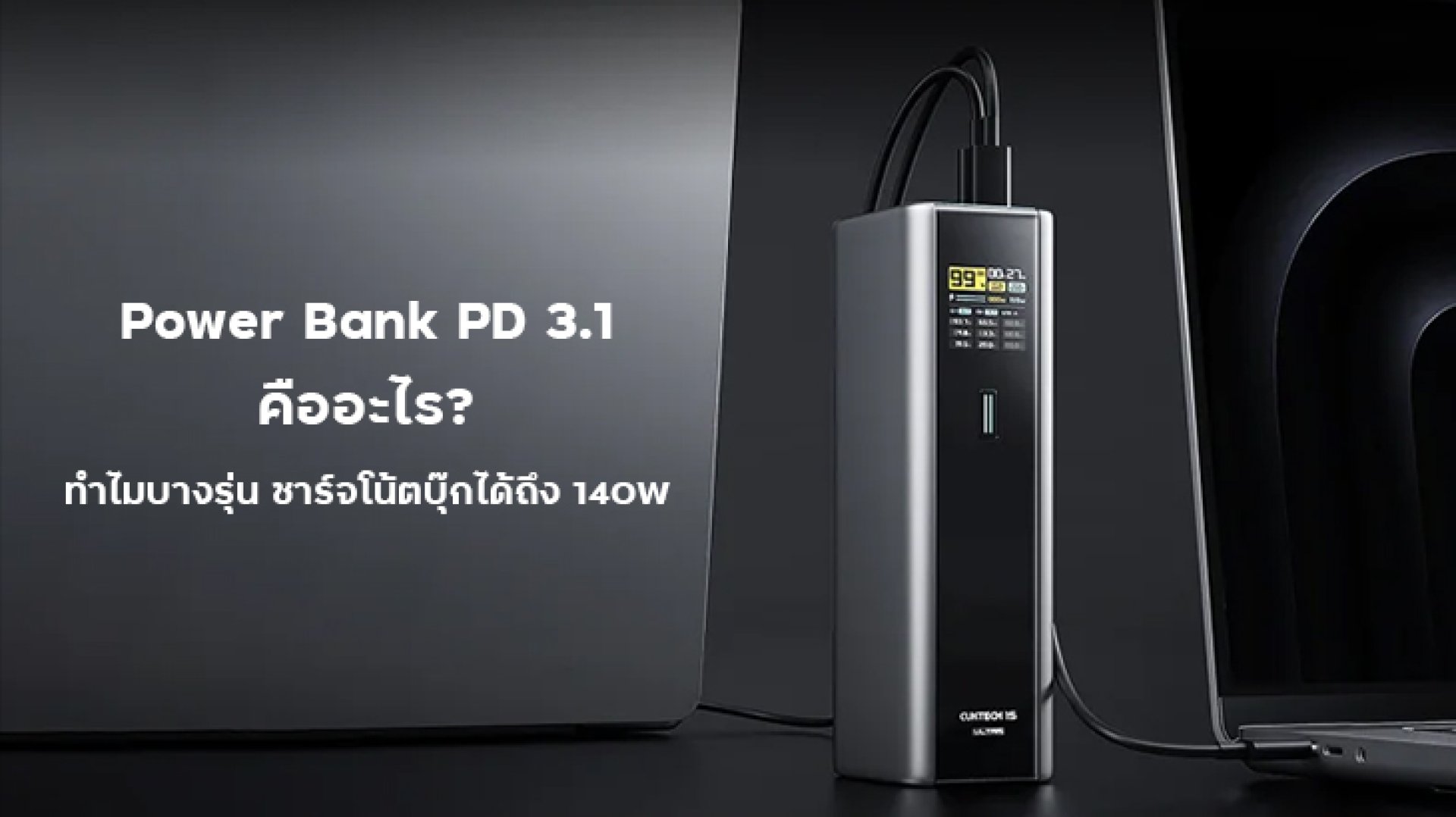
Have you ever wondered why some Power Banks can deliver up to 140W, while many conventional models provide only 20W, 30W, 65W, or 100W?
The key is USB Power Delivery 3.1, or USB PD 3.1. This standard expands the power capabilities of USB-C Power Delivery beyond the previous 100W level. With Extended Power Range (EPR), USB PD 3.1 can support power levels up to 240W when the Power Bank, device, and cable are all compatible.
That is why some PD 3.1 Power Banks can deliver up to 140W to compatible laptops. However, a 140W Power Bank does not automatically mean that every laptop will charge at 140W.
The actual charging power depends on the Power Bank, laptop, USB-C cable, supported power profiles, and the Power Delivery negotiation between the devices.
What Is a PD 3.1 Power Bank?
A PD 3.1 Power Bank is a portable battery that supports USB Power Delivery 3.1 capabilities through USB-C.
One of the most important features of USB PD 3.1 is Extended Power Range (EPR), which expands USB-C Power Delivery beyond the previous 100W limit.
USB-IF introduced new fixed voltage levels of 28V, 36V, and 48V for EPR, supporting maximum power levels of 140W, 180W, and 240W respectively when the complete system is compatible.
| USB PD Level | Example Voltage | Maximum Power |
|---|---|---|
| USB PD before 3.1 | Up to 20V / 5A | Up to 100W |
| USB PD 3.1 EPR | 28V / 5A | Up to 140W |
| USB PD 3.1 EPR | 36V / 5A | Up to 180W |
| USB PD 3.1 EPR | 48V / 5A | Up to 240W |
Important: These are power levels defined by the USB Power Delivery specification. A Power Bank labeled "PD 3.1" does not automatically mean that it can deliver 240W.
Why Can USB PD 3.1 Charge a Laptop at 140W?
The main reason is that USB PD 3.1 EPR introduces higher voltage levels than earlier USB Power Delivery implementations.
The basic power equation is:
Power (W) = Voltage (V) × Current (A)
For example:
- 20V × 5A = 100W
- 28V × 5A = 140W
- 36V × 5A = 180W
- 48V × 5A = 240W
By increasing the voltage from 20V to 28V, the system can move from the 100W range to 140W while remaining within the 5A current level in this example.
USB-IF introduced USB PD 3.1 to extend USB Power Delivery to devices that require more than 100W, including certain computers and other high-power USB-C devices.
Does a 140W Power Bank Charge Every Laptop at 140W?
No.
This is one of the most important things to understand before buying a 140W Power Bank.
A 140W rating means that the Power Bank has the capability to provide up to that amount of power under supported conditions. It does not mean that every connected laptop will automatically draw 140W.
The laptop determines how much power it can accept, while the Power Delivery system establishes an appropriate power contract between the source and the device.
| Power Bank | Laptop | Expected Result |
|---|---|---|
| 140W PD 3.1 | Maximum input 65W | The laptop will not receive 140W |
| 140W PD 3.1 | Maximum input 100W | The system operates within the supported power level |
| 140W PD 3.1 | Supports 140W PD EPR | Up to 140W may be possible when all components are compatible |
In other words, a 140W Power Bank does not force a laptop to consume 140W.
How Does USB Power Delivery Work Between a Power Bank and Laptop?
USB Power Delivery uses communication between connected devices to determine their power capabilities and requirements.
The process can be simplified as follows:
- The Power Bank acts as the Source.
- The laptop acts as the Sink.
- The devices communicate their power capabilities.
- The laptop requests an appropriate power level.
- The devices establish a Power Contract.
- The Power Bank supplies power according to the negotiated conditions.
This is why 140W printed on a Power Bank does not mean 140W is immediately delivered to the laptop.
USB-IF explains that USB Power Delivery allows devices to negotiate the power they require and manage power delivery between connected devices.
Are PD 3.1 and EPR the Same Thing?
Not exactly.
USB PD 3.1 is a version of the USB Power Delivery specification that introduced several capabilities, including support for higher power levels.
EPR (Extended Power Range) refers to the expanded power range within USB PD 3.1 that allows USB-C Power Delivery to operate above 100W.
A simple way to remember it is:
USB PD 3.1 EPR 140W / 180W / 240W power levels
What USB-C Cable Does a 140W PD 3.1 Power Bank Need?
The Power Bank is not the only component that matters. The USB-C cable is also an important part of a high-power charging system.
If you want to use higher USB-C power levels, check that the cable supports the required power rating and relevant USB-C specifications.
USB-IF's certified USB-C cable program includes power-rating markings for cables, including 60W and 240W categories.
USB-IF USB Type-C Cables and Connectors
Therefore, when using a high-output PD 3.1 Power Bank, do not look only for the "USB-C" label. Check the actual power rating of the cable.
What Does E-Marker Have to Do With a 140W Power Bank?
When you move into high-power USB-C charging, E-Marker becomes an important part of the discussion because certain USB-C cables use an electronically marked chip to identify their capabilities to the connected system.
For high-power applications, it is important to choose a cable with a clearly stated power rating and specifications that match the intended charging power.
USB-IF's USB Type-C specifications and certification requirements include requirements related to electronically marked cables and USB Power Delivery.
USB-IF USB Type-C Cable Power Rating Guidelines
100W Power Bank vs PD 3.1 140W Power Bank
| Feature | 100W Power Bank | PD 3.1 140W Power Bank |
|---|---|---|
| Maximum Power | Up to 100W | Up to 140W |
| USB PD EPR | Not required | Required for 140W operation |
| Smartphone | Suitable | Suitable |
| Tablet | Suitable | Suitable |
| USB-C Laptop | Suitable for many models | Suitable for models requiring higher power |
| Power Headroom | High | Higher |
If your device supports only 65W or 100W, moving from a 100W Power Bank to a 140W model does not necessarily make charging faster.
The additional power becomes more useful when the laptop itself supports USB PD EPR at higher power levels.
Who Should Buy a PD 3.1 Power Bank?
A PD 3.1 Power Bank is particularly useful for users who need more than basic smartphone charging.
- Users who charge laptops through USB-C
- Users who want one Power Bank for both laptops and smartphones
- Users who need more than 100W of available power
- Users with newer high-power USB-C devices
- Users who want additional power headroom for USB PD EPR-compatible devices
However, if you mainly charge a smartphone or tablet, a 140W Power Bank may provide much more power than the device can actually use.
Can a 140W PD 3.1 Power Bank Charge a Laptop and Phone at the Same Time?
It depends on the Power Bank's port configuration and power-sharing design.
Some Power Banks can charge multiple devices simultaneously, but the available power may be divided between ports when more than one device is connected.
For example, a Power Bank may advertise a high total output while limiting the maximum output of an individual port when another USB-C port is being used.
Always check the manufacturer's Output Distribution or multi-port charging specifications before buying.
Does a 140W Power Bank Always Consume More Power Than a 100W Model?
Not necessarily.
The maximum power rating indicates what the Power Bank can provide under supported conditions. It does not mean that the Power Bank constantly operates at 140W.
Actual power usage depends on the connected device, battery level, charging conditions, temperature, and the negotiated charging power.
How to Choose a PD 3.1 Power Bank for a Laptop
Before buying a Power Bank for a laptop, check these five points:
- Check the laptop's maximum USB-C charging input. For example, 65W, 100W, or 140W.
- Check whether the Power Bank supports USB PD 3.1.
- Check whether it supports EPR if you need more than 100W.
- Check the output of each USB-C port.
- Choose a USB-C cable with the appropriate power rating.
Do not choose a Power Bank based only on the "140W" number printed on the box. The important question is whether the Power Bank can provide a compatible Power Delivery profile for your specific laptop.
What Is a PD 3.1 Power Bank? Final Summary
A PD 3.1 Power Bank supports USB Power Delivery 3.1 capabilities, including Extended Power Range (EPR), which expands USB-C Power Delivery beyond the previous 100W level.
USB PD 3.1 EPR supports power levels of up to 140W, 180W, and 240W through 28V, 36V, and 48V fixed voltage levels respectively, when the complete system is compatible.
For a 140W Power Bank, the key level is 28V × 5A.
However, this does not mean every laptop can charge at 140W. Actual charging power depends on the laptop, Power Bank, USB-C cable, supported power profiles, and the negotiated Power Delivery contract.
So, when choosing a Power Bank for a laptop, look beyond the Watt number. Check PD 3.1 + EPR + Output Profile + Cable Rating together.
FAQ: PD 3.1 Power Bank
What is a PD 3.1 Power Bank?
A PD 3.1 Power Bank is a portable battery that supports USB Power Delivery 3.1 capabilities. With EPR support, it can operate at power levels above 100W when the connected devices and cable are compatible.
Can a 140W PD 3.1 Power Bank charge every laptop?
No. The laptop must support USB-C Power Delivery and the required power level. Always check the laptop's USB-C charging specifications.
What is the difference between PD 3.1 140W and PD 3.0 100W?
USB PD 3.1 introduced Extended Power Range, allowing USB-C Power Delivery to support higher power levels such as 140W, 180W, and 240W. Earlier USB PD implementations supported power levels up to 100W.
Does a 140W Power Bank require a 240W cable?
You should use a USB-C cable with a power rating appropriate for the charging system. Check the cable's certified or stated power rating along with the requirements of the Power Bank and laptop.
Can a 140W Power Bank charge a 45W smartphone?
Yes, provided the Power Bank and smartphone support compatible charging protocols and power profiles. The smartphone will draw power according to its own charging capabilities rather than being forced to accept 140W.
Related Articles
- What Cable Do You Need for a 100W Power Bank?
- What Is E-Marker? Why Do 100W / 240W USB-C Cables Need It?