Why Can a 45W Phone Use a 100W Charger? How USB PD Delivers Power
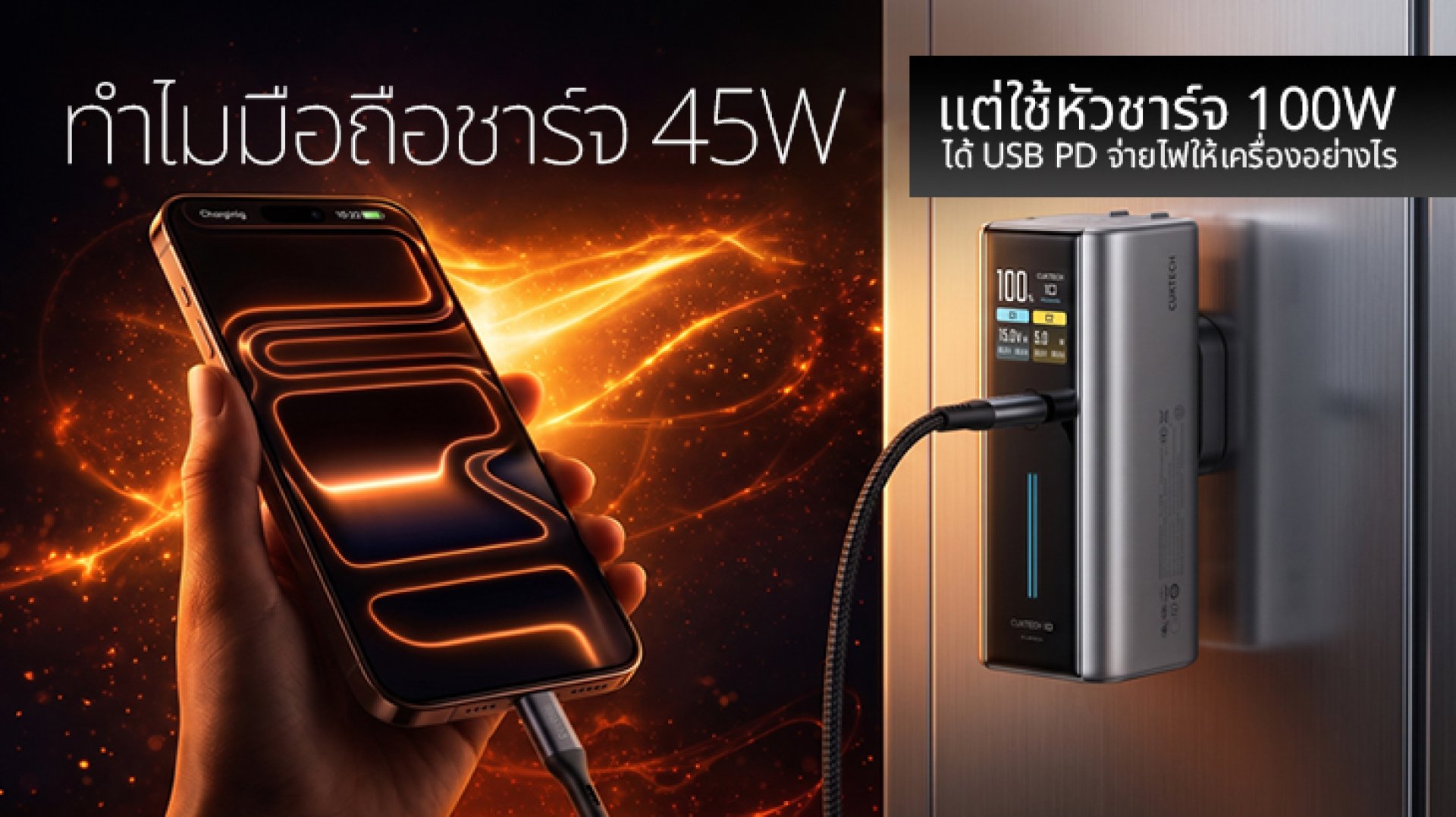
Have you ever wondered why a phone that supports up to 45W charging can safely be connected to a 100W USB-C charger? Some people see 100W on a charger and assume that the charger will force 100W into the phone and potentially damage it.
That is not how USB Power Delivery (USB PD) works. A 100W charger does not automatically force 100W into every connected device. Instead, the power source and the device communicate and negotiate the appropriate power level before charging at the agreed level.
So, if a phone supports up to 45W and you connect it to a compatible 100W USB-C charger, the phone can receive the power level it supports rather than automatically receiving 100W.
What Does a 100W Charger Actually Mean?
The 100W rating on a charger generally represents the maximum power output the charger can provide under its specified conditions and port configuration. It does not mean that every connected device will automatically receive 100W.
Think of a 100W charger as a power source that can provide up to 100W, while the phone determines how much power it can actually use.
| Device | Maximum Supported Power | When Connected to a 100W Charger |
|---|---|---|
| Smartphone | 45W | Receives power according to its supported level |
| Tablet | 65W | Can draw power according to its capability |
| Laptop | 100W | Can potentially use power up to its supported level |
USB-IF describes USB Power Delivery as a system that allows compatible devices to negotiate power requirements instead of simply delivering the maximum available power to every device.
How Does USB PD Work? The Charger Does Not Immediately Send 100W
The key concept is Power Delivery negotiation.
A USB PD system includes at least two important roles:
- Source the device that provides power, such as a USB-C charger
- Sink the device that receives power, such as a smartphone
When you connect a phone to a USB-C PD charger, the charger does not simply assume that it should output 100W. The devices communicate their capabilities and establish the conditions under which power will be delivered.
In simple terms:
Charger: Here are the power levels I can provide.
Phone: Here are the power levels I can accept.
USB PD: Let's use a power level that both sides support.
This agreed charging arrangement is commonly described as a Power Contract. USB-IF specifications and compliance testing cover Source and Sink behavior as well as USB PD power negotiation.
Example: 45W Phone + 100W Charger
Imagine you have two devices:
- A USB-C PD charger rated for up to 100W
- A smartphone that supports up to 45W charging
When you connect them, the charger does not simply push 100W into the phone. The USB PD system determines the compatible power capabilities and establishes the appropriate charging conditions.
If the phone supports and requests an appropriate 45W charging mode and the charger can provide it, the system can operate at that level.
| Component | Capability | Role |
|---|---|---|
| Charger | Up to 100W | Source |
| USB-C Cable | Must support the required power | Connection |
| Smartphone | Up to 45W | Sink |
The phone therefore does not receive 100W simply because the charger is rated at 100W.
Why Doesn't the Phone Take 100W If the Charger Can Provide It?
Because the charger's maximum output is a Source capability, not a command forcing the device to consume that amount of power.
A simple analogy is a water faucet:
- 100W charger = a faucet capable of supplying a large amount of water
- 45W phone = a device designed to accept only a certain amount
- USB PD = the control system that determines the appropriate delivery level
Having a higher-capacity power source does not mean the device has to consume all of it.
How Can USB PD Deliver 45W, 65W, or 100W?
The basic electrical formula is:
Power (W) = Voltage (V) × Current (A)
For example:
| Voltage | Current | Approximate Power |
|---|---|---|
| 5V | 3A | 15W |
| 9V | 3A | 27W |
| 15V | 3A | 45W |
| 20V | 3.25A | 65W |
| 20V | 5A | 100W |
These are examples used to explain the electrical relationship. They do not mean that every smartphone uses exactly these power profiles to achieve the advertised charging speed. Smartphone manufacturers can implement different charging conditions and may use USB PD together with PPS or proprietary charging technologies.
What Is PPS and Why Does It Matter for 45W Phone Charging?
If you have seen PD PPS on a charger specification, it can be important for certain smartphones and their fast-charging systems.
PPS (Programmable Power Supply) is a USB Power Delivery capability that allows the power source to adjust voltage within defined ranges more dynamically, helping compatible devices manage charging power more precisely.
This means a 100W charger that supports standard USB PD is not necessarily guaranteed to make every compatible phone charge at 45W. If a phone requires PPS or another specific charging protocol for its maximum charging speed, the charger must support the relevant capability as well.
That is why you should not look only at the 100W number when choosing a charger. You should also check whether it supports the required PD, PPS, or manufacturer-specific fast-charging protocol.
Does a 100W Charger Make a Phone Battery Degrade Faster?
Using a charger with a higher maximum power rating does not mean the phone will continuously receive that maximum power.
If the phone supports a maximum charging level of 45W, connecting it to a 100W charger does not automatically make the phone charge at 100W.
Actual charging behavior can also change depending on temperature, battery level, power-management behavior, and the manufacturer's charging strategy. Charging power can decrease as the battery approaches full capacity.
Can Every 45W Phone Use a 100W Charger at 45W?
Not necessarily.
You need to consider protocol and power-profile compatibility between the charger and the phone.
| Charger | Phone | Possible Result |
|---|---|---|
| 100W USB PD + PPS | Supports PD + PPS up to 45W | Can support compatible fast-charging modes |
| 100W USB PD | Uses a manufacturer-specific charging protocol | May charge, but maximum speed is not guaranteed |
| 100W charger | Phone supports only 25W | Phone remains limited by its own capability |
Therefore, the 100W label alone does not guarantee the maximum charging speed for every phone. Compatibility between the charging standards is what matters.
What Happens If a 100W Charger Has Multiple Ports?
Not every multi-port charger can provide 100W to every port simultaneously.
Some chargers can provide their maximum rated power when only one port is being used. When multiple devices are connected, the charger may distribute the available power between ports.
For example:
| Usage | Charger Capacity | What Can Happen |
|---|---|---|
| One smartphone | Up to 100W | Phone receives the power level it supports |
| Smartphone + tablet | 100W total | Available power may be distributed |
| Smartphone + laptop | 100W total | Each port may receive a different amount |
Always check the charger's output specifications rather than looking only at the 100W label.
100W on the Charger Is Not the Same as 100W Received by the Phone
This is the most important point to remember.
100W on the charger = the maximum capability of the power source.
45W on the phone = the phone's supported charging capability or limit.
Actual charging power = the result of the negotiated power level and system limitations.
That is why it is completely normal for a charger to have a much higher power rating than the smartphone connected to it.
Should You Buy a 100W Charger for a 45W Phone?
If you only need to charge one smartphone, a 100W charger may not make the phone charge faster than its supported 45W maximum.
However, a 100W charger can be useful if you want one charger for several types of devices, such as:
- Smartphones
- Tablets
- Power Banks
- USB-C laptops
- Other USB Power Delivery devices
The advantage is versatility. One high-power charger can support devices with different power requirements, while each device draws power according to its supported charging capabilities.
Conclusion: Can a 45W Phone Use a 100W Charger?
Yes, provided that the charger and phone support compatible standards and charging protocols.
The key point is that a 100W charger does not mean 100W is forced into the phone. USB Power Delivery is designed to allow the Source and Sink to communicate, negotiate their capabilities, and establish the appropriate power conditions.
Therefore, if a phone supports 45W and the charger supports 100W, the phone does not automatically receive 100W. The actual charging level depends on the phone's capabilities and the power profiles supported by both sides.
Remember it this way:
Maximum charger output actual phone charging power.
Actual charging depends on the combination of charger + USB PD/PPS + cable + phone + Power Contract.
FAQ: 45W Phones and 100W Chargers
Can a 45W phone use a 100W charger?
Yes. If the charger supports compatible standards and protocols, the phone can use it without automatically receiving 100W. The actual charging power is determined by the phone and the negotiated charging conditions.
Will a 100W charger damage a 45W phone?
A 100W rating represents the charger's maximum capability. It does not mean the charger will force 100W into the phone. Use a properly designed charger and cable that are compatible with the device.
Does a 45W phone need a 45W charger?
No. A charger can have a higher maximum power rating than the phone, as long as the charger supports the charging standards and protocols required by the phone.
Does a 100W charger make every 45W phone charge at 45W?
No. Maximum charging speed depends on the charging protocols and power profiles supported by both the charger and the phone. Some phones may require PPS or a manufacturer-specific charging technology.
How does USB PD prevent a phone from automatically receiving too much power?
USB PD uses communication between the Source and Sink to negotiate capabilities and establish charging conditions rather than simply delivering the charger's maximum power to every connected device.
Related Articles
- USB-C 100W vs 240W Cable: What's the Difference?
- What Cable Do You Need for a 100W Power Bank?
- Power Bank 100W vs 140W vs 240W: What's the Difference?