Is a 100W USB-C Charging Cable Necessary? How Much Power Does Your Phone Actually Need?
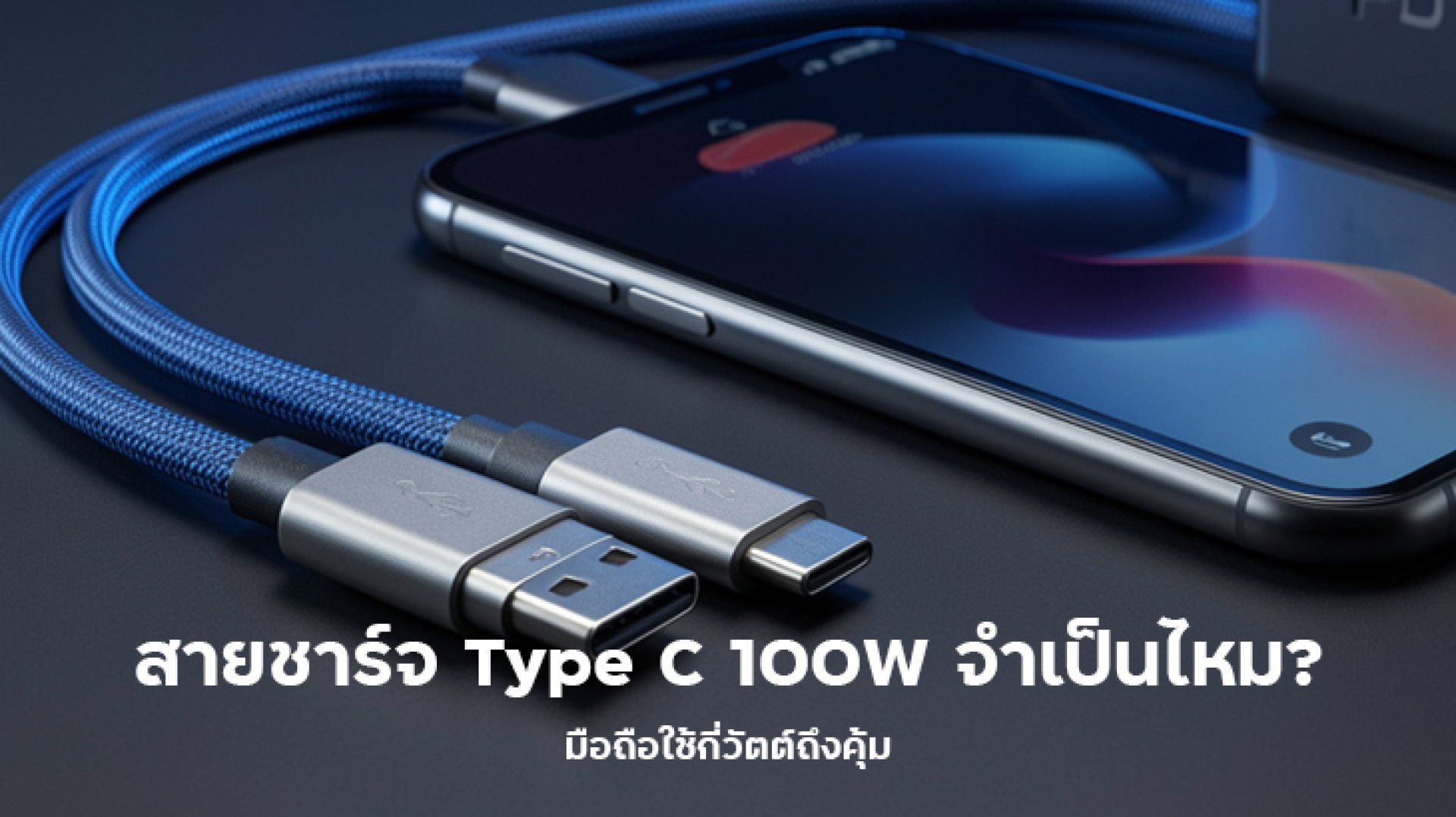
When shopping for a USB-C charging cable, you have probably seen labels such as 60W, 100W, or even 240W.
And that naturally raises a question:
If my phone doesn't charge at 100W, why would I need a 100W cable?
The short answer is: you don't necessarily need one.
If your smartphone supports only 20W, 25W, 33W, or 45W charging, buying a 100W USB-C cable will not automatically make the phone charge at 100W. The phone will still draw power according to its own charging capability and the charging standards supported by the device.
However, a 100W cable is not useless.
A high-wattage cable can be useful when you want to use the same cable with tablets, laptops, power banks, and other USB-C devices that require more power.
So instead of asking:
Is 100W too powerful for my phone?
The better question is:
What devices do I have, and what do I plan to use this cable for?
What Does 100W on a Charging Cable Actually Mean?
The 100W printed on a cable does not mean that the cable constantly pushes 100W into your phone.
Instead, it indicates the cable's maximum power-handling capability under the applicable specifications and conditions.
For example, imagine that your phone supports 25W charging.
You have:
- A 100W USB-C PD charger
- A 100W USB-C cable
- A smartphone that supports 25W charging
The phone does not suddenly start charging at 100W.
The device will negotiate power with the charger and operate within the charging limits supported by the phone and the charging system.
That is why using a 100W cable with a phone does not mean the phone will receive 100W.
Does a 100W USB-C Cable Make Charging Faster?
Not necessarily.
This is one of the most common misunderstandings when buying charging cables.
Charging speed does not depend on the cable alone. It is affected by several components working together:
Phone → Cable → Charger → Charging Protocol
If any part of the system does not support the required power level or charging protocol, charging speed may be limited.
| Device | Supported Power | Using a 100W Cable |
|---|---|---|
| Smartphone A | 25W | Works, but the phone still charges according to its own limits |
| Smartphone B | 45W | Works if the charger and charging standard support it |
| Tablet | 60W | A 100W cable can be useful |
| Laptop | 65W | A 100W cable is a suitable choice |
| Laptop | 100W | A cable rated for the required power level should be used |
Note: Actual charging power varies depending on the specific device model, charger, cable, and supported charging standards.
If You Only Use a Phone, Is a 100W Cable Worth It?
There are two situations to consider.
Case 1: You Only Use the Cable With a Smartphone
If your phone supports around 20W to 45W charging and you have no plans to use the cable with other high-power devices, a 100W cable may not be necessary.
A good-quality cable that supports the power requirements of your phone should be enough.
There is no need to spend extra money simply because the packaging says 100W.
Case 2: You Use Multiple Devices
If you have several devices such as:
- A smartphone
- A tablet
- A MacBook or USB-C laptop
- A USB-C power bank
- Other USB-C devices
A 100W cable becomes much more useful.
You can use one high-quality cable across multiple devices instead of carrying several different cables.
This is where a 100W cable can actually make sense.
What Is the Difference Between a 60W and 100W USB-C Cable?
Looking only at the numbers, the main difference is the maximum power level the cable is designed to support.
However, you should not choose a cable based only on whether it says 60W or 100W.
Two cables labeled 100W can have very different capabilities when it comes to data transfer, construction, and overall specifications.
Other things to check include:
- Whether the cable supports USB Power Delivery (USB PD)
- The supported power rating
- Data transfer speed
- Whether an E-Marker is included when required by the cable specification
- Cable construction and materials
- Cable length
- Connector quality
- Manufacturer specifications and certifications
Therefore:
100W does not automatically mean better than 60W.
It simply means that the cable is designed to support a higher power level under the appropriate conditions.
What Is an E-Marker and Why Does It Matter for 100W Cables?
When you start looking at higher-power USB-C cables, you will often come across the term E-Marker.
An E-Marker, short for Electronically Marked Cable, is electronic information stored in certain USB-C cables that allows the connected system to identify cable capabilities, including current capability and other supported characteristics.
This matters because not all USB-C cables have the same capabilities.
Two USB-C cables can look almost identical on the outside while having very different specifications internally.
That is why, when shopping for a 100W USB-C charging cable, you should not rely only on the 100W label on the packaging.
Check the manufacturer's specifications to understand what charging standards the cable supports and under what conditions it can deliver its rated power.
Can a 100W Cable Make Your Phone Hot or Damage the Battery?
The answer is the 100W rating on the cable does not automatically make your phone charge at 100W.
Charging temperature can be affected by several factors, including:
- The actual power being drawn by the device
- Charging circuit efficiency
- Ambient temperature
- Using the phone while charging
- Battery condition
- Quality of the charger and cable
- The device's thermal management system
So it would be misleading to assume:
100W cable = faster charging = faster battery degradation
The relationship is not that simple.
What matters more is using a quality charger and cable within the specifications supported by your device.
Can You Use a 100W Cable With a 25W Phone?
Yes.
This is one of the most common questions people have when shopping for high-wattage USB-C cables.
If your phone supports 25W charging and you use a USB-C cable rated for 100W, the phone is not forced to accept 100W.
The phone will negotiate charging power with the charging system and operate within its supported limits.
So:
25W Phone + 100W Cable = Works
But this does not mean:
25W Phone + 100W Cable = 100W Charging
Those are two very different things.
What About Using a 100W Charger With a 25W Phone?
The basic principle is similar.
A 100W charger does not force a phone to accept 100W.
The important thing is that the charger supports the charging standards required by the device and comes from a reputable manufacturer.
For example, if you have a 100W USB-C PD charger and connect it to a phone that supports 25W charging, the phone does not suddenly become a 100W device.
The phone remains limited by its own charging system.
Why Does a 100W Cable Sometimes Still Charge Slowly?
This is another situation that many people encounter.
You buy a cable labeled 100W, connect it to your device, and then wonder why you are not getting the expected charging speed.
There are several possible reasons.
1. The Charger Does Not Support the Required Power
If the charger cannot provide enough power or does not support the charging protocol required by the device, a 100W cable cannot compensate for it.
2. The Phone Supports a Lower Charging Power
If the phone supports only 25W, a 100W cable does not remove that limitation.
3. The Cable Does Not Actually Support the Required Specification
Always check the technical specifications provided by the manufacturer rather than relying only on marketing claims printed on the package.
4. The Device Uses a Proprietary or Specific Fast-Charging Standard
Some devices require specific charging standards or protocols to achieve their maximum charging speed.
That is why you should evaluate the entire charging system rather than choosing a cable based solely on its wattage rating.
Who Should Buy a 100W USB-C Charging Cable?
A 100W cable makes sense if you...
- Use a USB-C laptop
- Own a tablet that supports higher charging power
- Use multiple types of devices
- Want one cable for several devices
- Want to prepare for future devices
- Need a cable that supports more power than your current smartphone requires
You probably don't need one if you...
- Only use the cable with one smartphone
- Have a phone with relatively low charging power
- Do not own high-power USB-C devices
- Do not need to charge a laptop
- Already have a good 60W cable that meets your needs
So, What Wattage USB-C Cable Should You Buy?
A simple starting point is to match the cable to the devices you actually use.
| Use Case | USB-C Cable Wattage to Consider |
|---|---|
| Typical smartphone use | 60W is sufficient in many cases |
| Smartphone + tablet | 60W100W |
| Smartphone + laptop | 100W |
| High-power laptop | Check the laptop's specifications directly |
| One cable for multiple devices | 100W or higher depending on the devices |
| Planning for future devices | Consider 100W or higher depending on your needs |
Do not use this table as a substitute for the specifications of your individual devices. Actual charging power depends on the specific device and supported charging standards.
Do You Need a 240W USB-C Cable Instead?
For most smartphone users, probably not.
USB-C can support very high power levels under the appropriate USB Power Delivery specifications. However, a cable labeled 240W does not mean every connected device will charge at 240W.
If you only have a smartphone:
Buying a 240W cable for a 25W phone will not make the phone charge faster.
A 240W cable becomes useful when you have compatible devices capable of using higher power levels and you want a cable designed to support those requirements.
How to Choose a 100W USB-C Charging Cable Without Wasting Money
Before buying one, check these seven things.
1. Check How Much Power Your Device Supports
Start with the device, not the cable.
2. Check the Charger
The charger must support the required power level and charging standard for your device.
3. Check the Cable Specifications
Do not rely only on terms such as Fast Charge or 100W. Look at the actual technical specifications.
4. Check for E-Marker Where Applicable
For high-power USB-C cables, check the manufacturer's specifications to confirm that the cable has the required capabilities for its rated power level.
5. Check Data Transfer Speed
Some 100W cables are designed mainly for charging and may not provide high-speed data transfer.
If you plan to connect an SSD or another USB-C device, check the cable's data transfer specification as well.
6. Do Not Ignore Connector Quality
Even a well-designed cable can become unreliable if the connectors are poorly made.
7. Buying for the Future Is Fine, but Do Not Overbuy
If you only use a smartphone, a 100W cable may simply be future-proofing rather than something you actually need today.
Final Verdict: Is a 100W USB-C Cable Necessary?
If you want the straightforward answer:
No, it is not necessary for everyone.
A phone that supports 20W or 25W charging will not suddenly charge faster simply because you replace a 60W cable with a 100W cable.
However, if you use a smartphone, tablet, and USB-C laptop, investing in a good-quality 100W USB-C charging cable can make sense because you can use one cable across multiple devices.
So don't buy a cable simply because you see 100W printed on the package and assume it must be the best option.
Instead, check:
How much power does your device support + how much power can your charger provide + what standards does the cable support?
All three parts need to work together.
And the most important point is:
A 100W cable does not turn a 25W phone into a 100W phone.
FAQ
Can I use a 100W USB-C cable with a 25W phone?
Yes. A 100W USB-C cable can be used with a phone that supports 25W charging. The phone will draw power according to its supported charging capabilities rather than being forced to accept 100W.
Can a 100W charging cable damage a phone?
The 100W rating itself does not mean the cable will damage the phone. What matters is the quality of the cable and charger, supported charging standards, and compatibility with the device.
Does a 25W phone need a 100W USB-C cable?
Not necessarily. If you only use the cable with a 25W phone, a good-quality cable that supports the phone's requirements should be sufficient.
Does a 100W cable charge faster than a 60W cable?
Not necessarily. Actual charging speed depends on the phone, charger, cable, and charging protocol. If the phone is limited to 25W, using a 100W cable will not increase the charging speed to 100W.
Can a 100W USB-C cable be used with a laptop?
In many cases, yes. However, you should check the laptop's supported charging power and make sure both the charger and cable meet the required specifications.